
The CAEDA Cognitive Architecture is a cognitive architecture developed by Tristan Barnett that is designed to support multiple agents which must cooperate to solve a learning problem.

Background
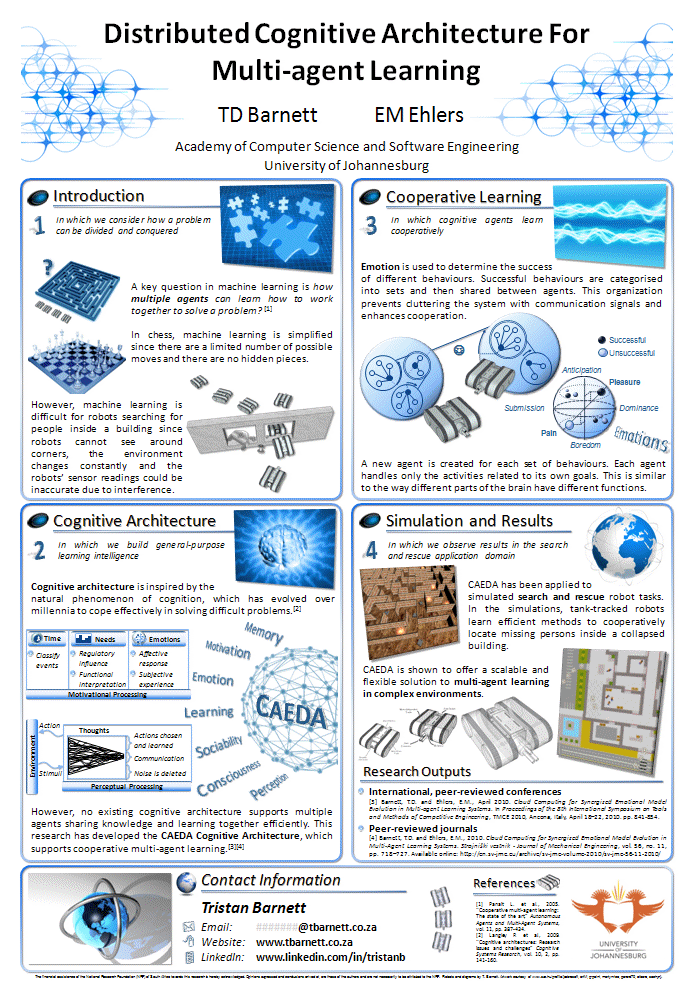
A key question in machine learning is how can multiple agents learn how to work together to solve a problem? Cognitive architecture is inspired by the natural phenomenon of cognition, which has evolved over millennia to cope effectively in solving difficult problems. However, more research is needed on cognitive architecture which supports multiple agents sharing knowledge and learning together efficiently.
CAEDA Cognitive Architecture
Approach
This research has developed the CAEDA Cognitive Architecture, which supports cooperative multi-agent learning. CAEDA has been applied to simulated search and rescue robot tasks. In the simulations, tank-tracked robots learn efficient methods to cooperatively locate missing persons inside a collapsed building.
Conclusion
CAEDA is shown to offer a scalable and flexible solution to multi-agent learning in complex environments and may prove to be a useful tool in robotic learning.
Publications
- Tristan Barnett and Ehlers, E.M., April 2010. Cloud Computing for Synergized Emotional Model Evolution in Multi-agent Learning Systems. In Proceedings of the 8th International Symposium on Tools and Methods of Competitive Engineering, TMCE 2010, Ancona, Italy, April 18–22, 2010. pp. 841-854.
- Tristan Barnett and Ehlers, E.M., 2010. Cloud Computing for Synergized Emotional Model Evolution in Multi-Agent Learning Systems. Strojniški vestnik – Journal of Mechanical Engineering, vol. 56, no. 11, pp. 718–727. Available online: http://en.sv-jme.eu/archive/sv-jme-volume-2010/sv-jme-56-11-2010/
Project summary
| Developer Tristan Barnett |
Date 2009-2012 |
| Achievements
Podium presentation at TMCE 2010, an international, peer-reviewed conference held in Ancona, Italy.
Publication in the peer-reviewed Journal of Mechanical Engineering.
|
|
Technologies Used
|
|
-
- CAEDA Cognitive Architecture

Recent Comments